
How Physical Education Can Teach Children How to Learn
Most parents think of physical education as a way for kids to stay active. Movement matters. Health matters. But physical education can offer something far more important than exercise alone.
When designed with intention, physical education can teach children how learning actually works.
This distinction matters, especially for homeschool families who are thoughtful about how every subject fits into their child’s education. When learning feels meaningful, it stays. When it feels unclear, it often gets set aside.
Learning Is a Process, Not a Personality Trait
Children are often labeled early. Good reader. Math kid. Athletic. Not coordinated. Those labels tend to stick because many learning environments focus on outcomes instead of process.
But real learning happens differently.
Children learn through effort, feedback, adjustment, and repetition. They try something. It does not work yet. They make a correction. They try again. Over time, progress appears.
This learning pattern is the foundation of academics, whether a child is learning to read, write, solve math problems, or think critically. Learning is not about talent or personality. It is about engaging with a process long enough for improvement to take place.
When children understand this, learning becomes less intimidating and more accessible.
Why Movement Is a Powerful Teacher
Skill-based physical education mirrors the learning process in a way children can feel immediately.
When kids practice guided, repeatable movement, they experience cause and effect in real time. Effort leads to improvement. Practice leads to progress. Mistakes become information instead of failure.
Because movement is physical and visible, children can see learning happening. A stance becomes steadier. Balance improves. Coordination develops. A challenge that once felt awkward begins to feel controlled.
That experience matters. It gives children proof that learning is something they can influence.
From Movement to Mindset
When children experience progress through effort, something important shifts.
They begin to trust the process. They stop relying solely on praise or external motivation. They start to believe that learning is something they can shape through practice and persistence.
This is where physical education supports academics.
Children who understand that effort leads to improvement are more likely to stay with challenging reading assignments, unfamiliar math concepts, and difficult problem-solving tasks. They are less likely to shut down when something feels hard, because they have practiced staying with discomfort in a safe, structured way.
They have practiced learning itself.
Why This Matters for Homeschool Families
Homeschool parents see learning up close every day. They notice when a child avoids challenges, rushes through work, or loses confidence quickly. They also notice when a child becomes focused, resilient, and willing to try again.
Physical education that lacks structure rarely supports those qualities. Activity alone does not teach learning habits.
Skill-based physical education does.
When movement is guided, consistent, and purposeful, it reinforces the same learning patterns parents are trying to build across subjects. Physical education stops being “extra” and starts becoming supportive of the entire learning day.
Why Karate Is Especially Effective as Physical Education
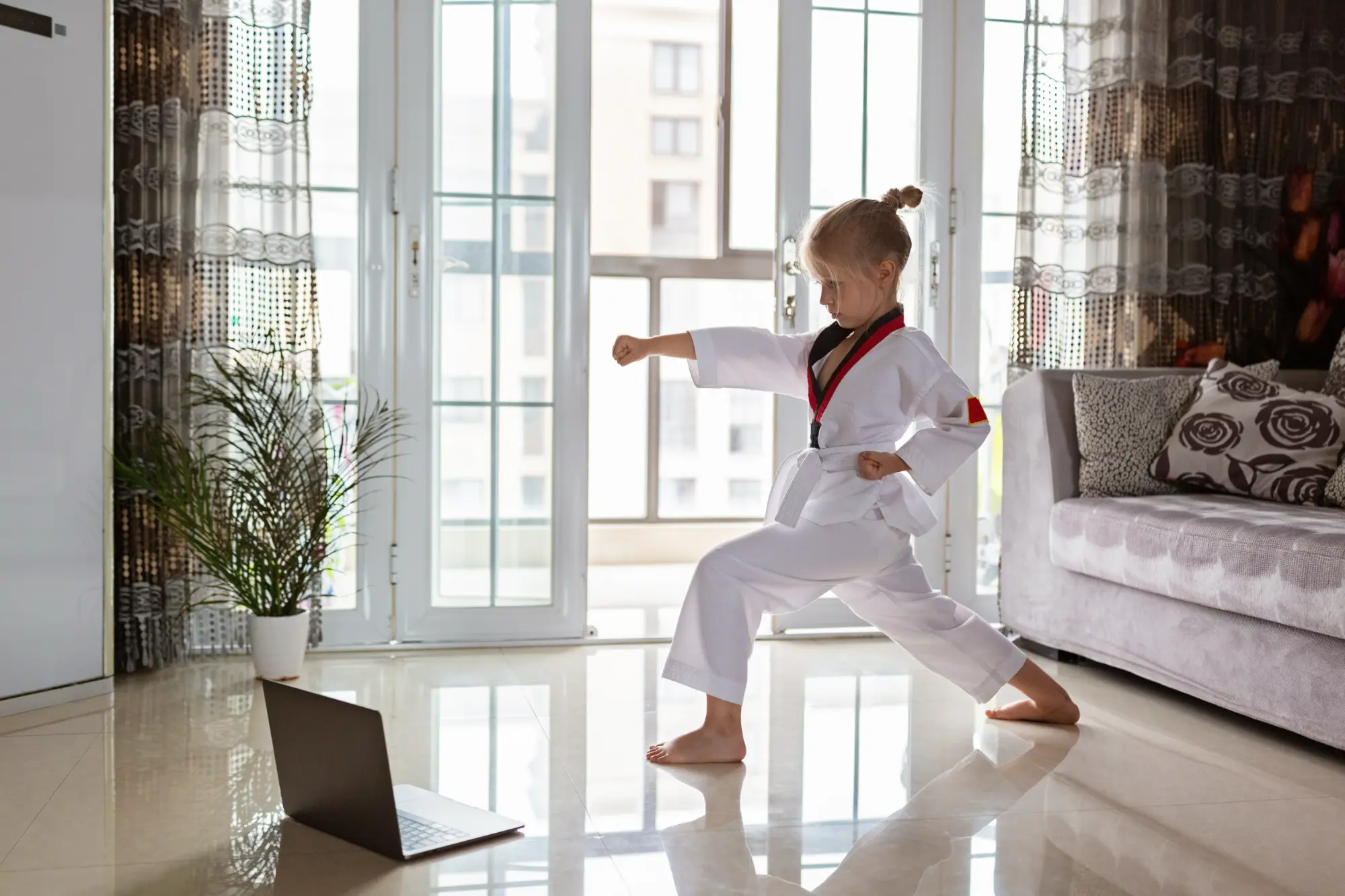
Karate works particularly well as skill-based physical education because it breaks learning into clear, repeatable pieces.
Stances. Blocks. Punches. Kicks. Each movement has a form and a purpose. Children practice one element at a time, improving control, balance, and coordination through repetition rather than pressure.
Kids often love karate because it helps them feel capable in their own bodies. When their body does what they tell it to do, confidence grows naturally. Movements feel sharper. Timing improves. Strength shows up in controlled, intentional ways.
Karate also teaches body awareness and focus. Children learn how to start, stop, and move with precision. They practice staying present, following sequences, and controlling their movements, all while staying engaged and active.
Forms, Patterns, and Memory
One of the most powerful learning tools in karate is the practice of forms.
Forms are structured movement patterns performed in a specific sequence. For children, they function like physical patterns that must be remembered, practiced, and refined.
As students work through forms, they are sequencing actions, coordinating both sides of the body, and holding patterns in memory while moving through space. Over time, the movements become smoother and more confident as understanding deepens.
This type of patterned movement strongly supports memory, focus, and concentration. Children experience what it feels like to remember, correct, and improve. Progress is visible, and that reinforces learning in a powerful way.
Language, History, and Learning Beyond Movement
Karate also introduces children to learning beyond physical skills.
Students learn terminology from both Japanese karate and Korean Taekwondo traditions. They learn counting, directional terms, and technique names in another language. This strengthens listening skills, attention to detail, and memory.
Children also learn that martial arts have history and cultural roots. Karate’s Japanese origins and Taekwondo’s Korean influence help students understand that what they are practicing has meaning beyond the movement itself.
This adds depth and context to training and gives children another way to engage intellectually with physical education.
What This Looks Like in Practice at Great Start Karate
At Great Start Karate, our live online karate classes are designed around this understanding of learning.
Students work on specific skills over time in a structured, supportive environment. Progress is visible. Effort matters. Improvement is expected and celebrated.
The goal is not just physical ability. The goal is helping children develop focus, perseverance, coordination, and confidence that carry into schoolwork and everyday life.
Physical education does not have to sit outside the learning day. When designed well, it becomes part of how children learn best.
A Different Way to Think About PE
Physical education does not have to be random activity or something squeezed in when time allows.
When it is skill-based and intentional, physical education teaches children how learning works.
At Great Start Karate, this philosophy guides everything we do. Karate is the vehicle. Learning is the destination.
This approach is also the foundation of the philosophy shared in the book PE With a Purpose, written for families who want physical education to support learning, confidence, and character.
For families reconsidering the role of PE in their homeschool, the question is no longer whether physical education matters.
It is whether it has been designed to teach children how to learn.